
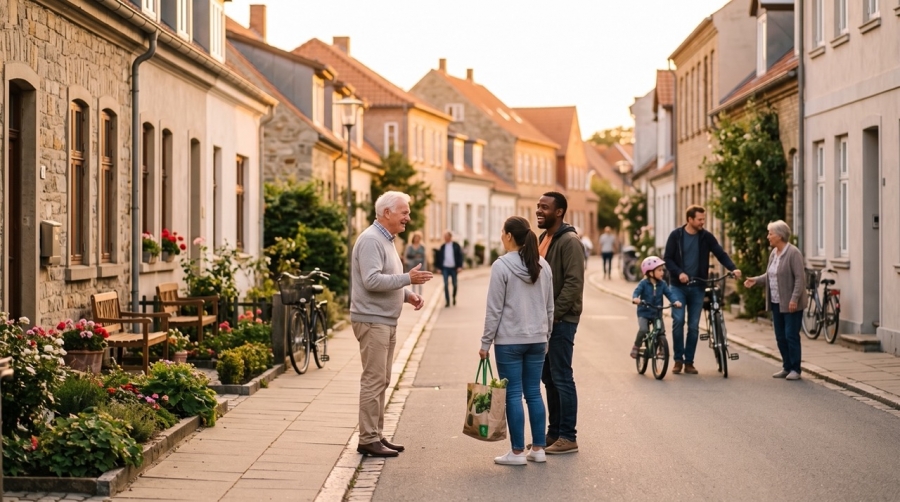
To those looking in from the outside, Neighbourhood Watch may conjure up images of CCTV cameras, incident reports and procedures. What we have come to recognise, however, is something rather different: people getting to know one another, relationships growing stronger, and communities rediscovering the value of shared responsibility.
Over the years, EUNWA has had the privilege of observing, supporting and connecting associations, volunteers and communities across Europe. One simple yet profound conviction has emerged from this experience: no one is ever truly safe alone.
Time and again, we have encountered seemingly small moments capable of bringing about meaningful change. We have seen neighbours who had passed one another for years without speaking begin to get to know and support each other. We have seen residents draw attention to signs of vulnerability before they developed into more serious problems. We have seen older people feel less isolated, families become more involved in community life, and local authorities discover that working with residents can be a valuable resource.
Taken individually, such moments may appear of little consequence. In reality, they offer tangible proof that safety often begins with everyday gestures and relationships built over time.
We live in an age of unprecedented connectivity, yet loneliness, mistrust and indifference seem to be increasingly widespread. In this context, Neighbourhood Watch is far more than a crime-prevention initiative. It is an attempt to rebuild connections, shared responsibility and mutual trust.
The Nordic countries are often held up as examples of societies marked by high levels of social trust, strong cooperation between citizens and institutions, and a deep-rooted sense of belonging.
It would, of course, be naive to imagine that these models could simply be transplanted elsewhere. Trust in institutions, and in society more broadly, is the outcome of a long historical, cultural and political process that unfolds over generations.
We cannot import another country’s history, but we can learn from what that history has to teach us.
Our aim is not to replicate Denmark, Norway or the Netherlands. It is to understand the principles that have enabled those societies to strengthen mutual trust and to adapt them to our own circumstances.
Trust, however, is not enough. On its own, it cannot prevent a crime, protect someone who is vulnerable or solve a problem. This is one of the most common objections, and one of the most valid. Yet without trust, it becomes far more difficult to prevent risks, identify vulnerabilities and mobilise the resources needed to address them.
Prevention, training, the identification of vulnerabilities within the community, and cooperation with institutions must all stand alongside trust. Without these elements, the model loses effectiveness; without trust, however, their impact is inevitably diminished.
There are also those who fear that Neighbourhood Watch may foster exclusion.
Some observers argue that it could become a closed circle, wary of anyone perceived as different. Our experience, however, points in another direction.
Neighbourhood Watch groups bring together people of different ages, occupations, cultures, backgrounds and economic circumstances. Their composition will naturally reflect the neighbourhoods in which they operate, but this is not an inherent feature of the model itself.
There is a crucial distinction between a group happening to consist of people with similar backgrounds and a group deliberately excluding those who are different.
Neighbourhood Watch does not ask people to be alike. It asks them to share responsibility.
The role of volunteers is also often misunderstood.
It is true that volunteers are not professionals. That is precisely why their remit must remain clearly defined.
Neighbourhood Watch does not turn residents into police officers, nor does it replace public institutions. Rather, it values a different kind of knowledge: the understanding that comes from knowing an area, from everyday relationships, and from noticing changes that an outsider might easily miss.
Ongoing training and close cooperation with the relevant authorities are essential to reducing the risk of mistakes and ensuring responsible action.
There are also those who argue that Neighbourhood Watch relies on the commitment of only a small number of people.
This criticism is partly justified. Participants represent only a small proportion of the population, but that does not mean the wider community cannot benefit from their contribution.
Experience shows that even a relatively small group of people can have a positive effect on safety, mutual trust and social cohesion.
Were the behaviours, attitudes and principles associated with Neighbourhood Watch embraced by more citizens, our communities could become safer, stronger and more resilient.
At this point, it is reasonable to ask what broader purpose all this serves. Is it simply about reducing crime? Increasing surveillance? Making the exchange of information more efficient?
Our answer goes further.
The purpose of Neighbourhood Watch is not merely to improve safety, but also to help create the conditions in which people can live with confidence, form relationships, develop their abilities and contribute to the community around them.
This is where the idea of the common good comes into play.
Some regard it as too abstract or too vague. For us, however, the common good encompasses all those achievements and conditions that enable each person to shape and pursue a life of their own choosing, while also contributing to the growth, well-being and prosperity of the community as a whole.
Safety, trust, solidarity, a sense of belonging and shared responsibility are not separate ideas. They are different facets of the same reality.
Finally, some argue that the aims of Neighbourhood Watch are overly ambitious.
That criticism, too, needs to be put into perspective.
Neighbourhood Watch does not claim to solve every problem in society, still less to save the world. Its focus is far more tangible: the street, the neighbourhood, the village, the town and the city.
It is precisely at this seemingly modest scale that its most meaningful results emerge.
Perhaps the most important lesson we at EUNWA have learnt over the years is that safety is not merely the absence of danger.
Safety also means being able to trust others. It is the knowledge that we can rely on them and the certainty that we are not alone.
We have learnt that a community does not grow stronger through mutual suspicion, but when people get to know one another, work together and take on shared responsibilities.
We have learnt that prevention is more effective when it is rooted in human relationships, and that a community’s resilience depends on its members’ ability to face difficulties together.
Above all, we have learnt that the strongest communities are not those that build the highest walls, but those that build the strongest bridges.
And that, in our view, is the deepest meaning of Neighbourhood Watch.